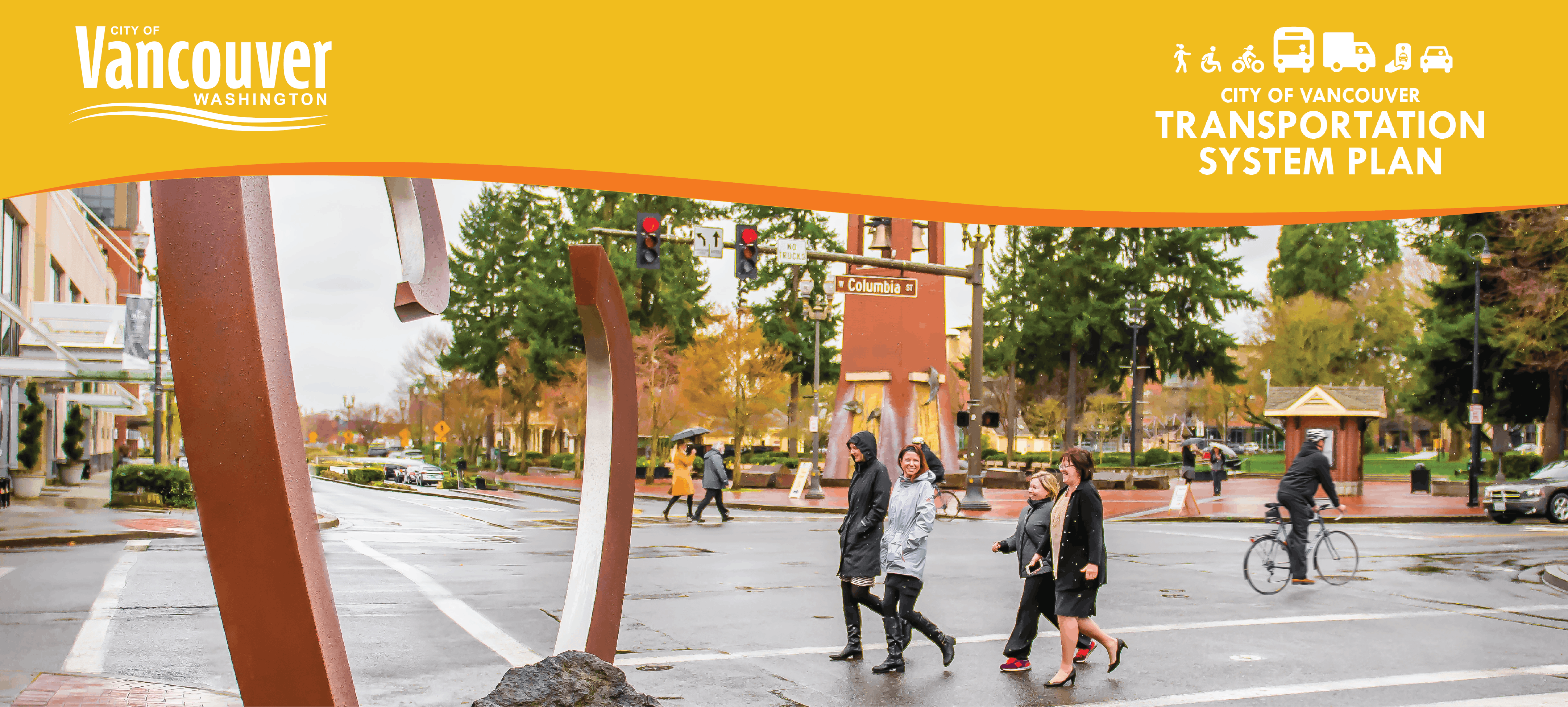
Transportation System Plan
Consultation has concluded
Plan Adopted: January 2024
The Transportation System Plan was approved and adopted by Vancouver City Council on the 8th of January, 2024. Review the final TSP Plan and appendices in the Project Documents on the right side of the page.
The City of Vancouver is proud to share the 2024 Transportation System Plan (TSP). The TSP is the broad vision for our transportation system – and a roadmap for getting there. The TSP will guide investments in our transportation system for the next 20 years. Vancouver’s transportation system includes our network of streets, sidewalks, bicycle routes, bus routes, trails, and ADA-accessible facilities.
Since the last TSP was published in 2004, our City has grown and more people and businesses now call Vancouver home. The TSP will help us address new transportation trends resulting from this growth while supporting the City’s broader goals around transportation safety, climate-friendly transportation, and equitable travel options for all people.
Most importantly, the TSP is a community-driven planning process to shape the future of our transportation system for the next 20 years. Since the project launched in 2020, we’ve spoken and heard from hundreds of Vancouver residents, businesses, and organizations online and through in-person outreach at Farmer’s Markets, schools, and neighborhood associations. Now, we’re ready to share the Plan with the community.
The draft and final Plans went through formal review and public comment periods in front of the Vancouver Transportation Mobility Commission and Vancouver City Council in December 2023 and the plan was adopted by City Council in January 2024.
What is a Transportation System Plan?
A Transportation System Plan will help guide the City's future transportation system and serves as the update to the City's previous Transportation System Plan, last updated in 2004. The plan will explore transportation needs and priorities in partnership with Vancouver residents, employees, and visitors.
The Transportation System Plan examines existing travel conditions for all users of the city's transportation system, including those who drive, walk, bicycle, ride transit, or deliver freight. The City spoke to residents about their transportation priorities, with additional focus on communities that have been historically under-served by transportation investments.
Building from these conversations over the coming year, the Transportation System Plan identifies recommended policies, programs, and projects to guide the City's transportation future.
Why Transportation Matters
Vancouver residents depend on the transportation system every day.
Transportation matters because everyone in Vancouver deserves a safe and reliable transportation system that meets their daily needs. Much has changed since the City’s current Transportation System Plan was adopted in 2004. Since 2010, Vancouver has welcomed more than 14,000 new residents and 10,000 new jobs, meaning the transportation system must meet the needs of a growing community. The transportation system must also adapt to changing community needs, while supporting the city's health and economy.
Plan Adopted: January 2024
The Transportation System Plan was approved and adopted by Vancouver City Council on the 8th of January, 2024. Review the final TSP Plan and appendices in the Project Documents on the right side of the page.
The City of Vancouver is proud to share the 2024 Transportation System Plan (TSP). The TSP is the broad vision for our transportation system – and a roadmap for getting there. The TSP will guide investments in our transportation system for the next 20 years. Vancouver’s transportation system includes our network of streets, sidewalks, bicycle routes, bus routes, trails, and ADA-accessible facilities.
Since the last TSP was published in 2004, our City has grown and more people and businesses now call Vancouver home. The TSP will help us address new transportation trends resulting from this growth while supporting the City’s broader goals around transportation safety, climate-friendly transportation, and equitable travel options for all people.
Most importantly, the TSP is a community-driven planning process to shape the future of our transportation system for the next 20 years. Since the project launched in 2020, we’ve spoken and heard from hundreds of Vancouver residents, businesses, and organizations online and through in-person outreach at Farmer’s Markets, schools, and neighborhood associations. Now, we’re ready to share the Plan with the community.
The draft and final Plans went through formal review and public comment periods in front of the Vancouver Transportation Mobility Commission and Vancouver City Council in December 2023 and the plan was adopted by City Council in January 2024.
What is a Transportation System Plan?
A Transportation System Plan will help guide the City's future transportation system and serves as the update to the City's previous Transportation System Plan, last updated in 2004. The plan will explore transportation needs and priorities in partnership with Vancouver residents, employees, and visitors.
The Transportation System Plan examines existing travel conditions for all users of the city's transportation system, including those who drive, walk, bicycle, ride transit, or deliver freight. The City spoke to residents about their transportation priorities, with additional focus on communities that have been historically under-served by transportation investments.
Building from these conversations over the coming year, the Transportation System Plan identifies recommended policies, programs, and projects to guide the City's transportation future.
Why Transportation Matters
Vancouver residents depend on the transportation system every day.
Transportation matters because everyone in Vancouver deserves a safe and reliable transportation system that meets their daily needs. Much has changed since the City’s current Transportation System Plan was adopted in 2004. Since 2010, Vancouver has welcomed more than 14,000 new residents and 10,000 new jobs, meaning the transportation system must meet the needs of a growing community. The transportation system must also adapt to changing community needs, while supporting the city's health and economy.
Tell Us Your Transportation Story
This is the place where you can share your own personal story about how transportation affects your daily life in Vancouver.
You can share anything you want, but here are some examples of things you could tell us:
- What are travel conditions like where you live, work or commute?
- Do you usually drive, walk, bike, ride transit or something else?
- Where do you usually go and what are your favorite places to visit in the city?
- How long is your average trip?
- What do you like about the city's transportation system?
- Do you feel safe travelling in Vancouver?
- What transportation topics are important to you?
Please note that your story will be visible to all users after you submit it.
-
Share NE 88th Street and the Street Racer Wannabes on Facebook Share NE 88th Street and the Street Racer Wannabes on Twitter Share NE 88th Street and the Street Racer Wannabes on Linkedin Email NE 88th Street and the Street Racer Wannabes link
NE 88th Street and the Street Racer Wannabes
by Cody, almost 3 years agoNE 88th is a nice place to live, or rather, I wish it was.The road bisects the lovely Curtin Creek, with tall trees that cast shade and enclose the space, making it a beautiful place to walk, if it weren't for the terrible road. Drivers like to use it as a shortcut from Padden, and it's become a hotspot for people with their suped-up trash cars to blare down the road at all hours of the night, engines backfiring the whole way.
Large stretches of the road lack sidewalks or any real curb at all, making pedestrian and bike... Continue reading
NE 88th is a nice place to live, or rather, I wish it was.The road bisects the lovely Curtin Creek, with tall trees that cast shade and enclose the space, making it a beautiful place to walk, if it weren't for the terrible road. Drivers like to use it as a shortcut from Padden, and it's become a hotspot for people with their suped-up trash cars to blare down the road at all hours of the night, engines backfiring the whole way.
Large stretches of the road lack sidewalks or any real curb at all, making pedestrian and bike navigation risky. Because of that, the sidewalks that do exist are rarely ever used. Plus, if one wants to access the nearby shopping center, one has to cross a busy, ugly, smelly, dangerous intersection.
What I'd like to see is more traffic calming features on 88th, and a full length sidewalk. It's a bit of a narrow road, so perhaps it could be made into a one-way going west. If this is achieved, I'm sure it would become a better, more comfortable place to live.
-
Share Improve the Long-Neglected 4th Plain & F Street Intersection on Facebook Share Improve the Long-Neglected 4th Plain & F Street Intersection on Twitter Share Improve the Long-Neglected 4th Plain & F Street Intersection on Linkedin Email Improve the Long-Neglected 4th Plain & F Street Intersection link
Improve the Long-Neglected 4th Plain & F Street Intersection
by Kat, over 3 years agoThe intersection of 4th Plain and F Street must be reimagined and made safer due to its dangerous risk factors such as high traffic, limited visibility, congestion, speeding and/or vehicles frequently running red lights. There are two crosswalks. Pedestrian lights take a long time to flash the walk signal. It is very dangerous for school children at VSAA, Discovery Middle School and Hough Elementary that cross here twice a day, especially when it’s dark. The lights are long, and there isn’t a buffer or shelter to stand and wait until it’s safe to cross. Some pedestrians become impatient by having... Continue reading
The intersection of 4th Plain and F Street must be reimagined and made safer due to its dangerous risk factors such as high traffic, limited visibility, congestion, speeding and/or vehicles frequently running red lights. There are two crosswalks. Pedestrian lights take a long time to flash the walk signal. It is very dangerous for school children at VSAA, Discovery Middle School and Hough Elementary that cross here twice a day, especially when it’s dark. The lights are long, and there isn’t a buffer or shelter to stand and wait until it’s safe to cross. Some pedestrians become impatient by having to wait so long, especially in inclement weather, and so cross against the red light. Cars frequently run red lights. I’ve witnessed many pedestrians, including myself, almost get hit by vehicles entering the intersection. My 84 father crosses this area daily among many senior citizens and people with compromised or limited mobility, sight and/or hearing impairments. The crosswalk is in a blind spot for cars turning left (eastbound) onto 4th Plain from F Street, putting those using the crosswalks in danger. This intersection needs much immediate attention. I have brought this issue to the attention of the city multiple times over the past years, but so far I have not heard back from one person and it seems nothing has been done to, at least, make temporary improvements,. Pedestrian Hybrid Beacon Crosswalks with flashing lights need to be installed to decrease the above risk factors and barriers compromising the safety of pedestrians, bicyclists and cars. I’m surprised there hasn’t been a fatality as of yet.
-
Share 94th Street beautification on Facebook Share 94th Street beautification on Twitter Share 94th Street beautification on Linkedin Email 94th Street beautification link
94th Street beautification
by Debbie, over 3 years agoHi there. I have lived in Vancouver now for 1.5 years and really enjoy my neighborhood in NE Vancouver near Costco. However it is downright depressing to lea e Padden Prkwy heading south on 94th as the streets appear totlu unkempt, weeds abound and trash everywhere. Is there a time scheduled for maintenance and beautification efforts? Why are some areas well maintained and others let go completely? I am urious how funds are prioritized and distributed to street projects? How can I help relieve this tired rundown area become visually happy and bright for those that live and drive this... Continue readingHi there. I have lived in Vancouver now for 1.5 years and really enjoy my neighborhood in NE Vancouver near Costco. However it is downright depressing to lea e Padden Prkwy heading south on 94th as the streets appear totlu unkempt, weeds abound and trash everywhere. Is there a time scheduled for maintenance and beautification efforts? Why are some areas well maintained and others let go completely? I am urious how funds are prioritized and distributed to street projects? How can I help relieve this tired rundown area become visually happy and bright for those that live and drive this area? I would love to get involved. -
Share Light Rail on Facebook Share Light Rail on Twitter Share Light Rail on Linkedin Email Light Rail link
Light Rail
by Senior, about 4 years agoI'm very much looking forward to light rail coming to Vancouver someday. I'm a senior citizen, and the bus stops closest to me are a bit far. I don't understand why some are phobic about light rail. It's quick and easy transportation. It would be run by CTran, not Trimet.
I'm very much looking forward to light rail coming to Vancouver someday. I'm a senior citizen, and the bus stops closest to me are a bit far. I don't understand why some are phobic about light rail. It's quick and easy transportation. It would be run by CTran, not Trimet.
-
Share Let's Rethink Some of This... on Facebook Share Let's Rethink Some of This... on Twitter Share Let's Rethink Some of This... on Linkedin Email Let's Rethink Some of This... link
Let's Rethink Some of This...
by Not a Suburb of Portland, about 4 years agoI moved to Vancouver over 20 years ago, wanting a place that I could raise my children, feel safe, and take pride in my community. I have not been disappointed until recently.It saddens me to hear that we are now considered a "suburb of Portland, Oregon", because Vancouver is, and always has been, so much more than that. We are not a suburb of Portland, nor do most of us want to be. The recent announcement of the support by City Council of the light rail coming to Vancouver is as alarming as the recent development that has, unfortunately... Continue reading
I moved to Vancouver over 20 years ago, wanting a place that I could raise my children, feel safe, and take pride in my community. I have not been disappointed until recently.It saddens me to hear that we are now considered a "suburb of Portland, Oregon", because Vancouver is, and always has been, so much more than that. We are not a suburb of Portland, nor do most of us want to be. The recent announcement of the support by City Council of the light rail coming to Vancouver is as alarming as the recent development that has, unfortunately, attracted more crime and violence (nightly shootings and robberies, etc.) than we have ever seen before. And the events are not only in my area, but are becoming more and more widespread.
When dealing with traffic, however, let's consider the issues we are already facing prior to inviting more trouble with the 'Max'. For example, if you are on Esther and 8th Streets near the park, be on alert! Rarely do cars stop at the stop signs located on each of the corners. When my son tries to cross the street near our home, cars do not stop - in fact, if I had not been there, he would have been killed the other morning just walking to the school bus - because of cars speeding through the Esther Short area at all times of day and night. Can we focus on some of the issues described by residents on this page first before adding more chaos to the traffic issue with the introduction of the 'Max'?
Someone mentioned the Columbia Street bike lane project. I can see where the benefit was supposed to be, but am getting lost in what is really happening. Are cars really supposed to be parking in the middle of the street on the diagonal lines? Everyone I have asked is as confused as I am about this. Also, I do not see many bikers on Columbia on a daily basis anymore. What happened?
Thanks for your time...let's hope we can address and upgrade one thing at a time - starting with preexisting in-town areas of concern, please. :)
-
Share Afraid to cross the street on foot on Facebook Share Afraid to cross the street on foot on Twitter Share Afraid to cross the street on foot on Linkedin Email Afraid to cross the street on foot link
Afraid to cross the street on foot
by MintyFresh, over 4 years agoI live in Ellsworth Springs, very close to I-205 and SE 10th St. I can walk around my block, but I have observed that the intersections at 10th St and Ellsworth, 205 and Chkalov are dangerous to the few pedestrians that dare cross the road. Cars here are generally not expecting pedestrians. The one time I tried to cross 10th going north, pushing my kid in a stroller, a Southbound SUV on Ellsworth nearly plowed us down in the intersection. That was 7 years ago and I have avoided crossing 10th Ave. on foot since. I wonder if there is... Continue reading
I live in Ellsworth Springs, very close to I-205 and SE 10th St. I can walk around my block, but I have observed that the intersections at 10th St and Ellsworth, 205 and Chkalov are dangerous to the few pedestrians that dare cross the road. Cars here are generally not expecting pedestrians. The one time I tried to cross 10th going north, pushing my kid in a stroller, a Southbound SUV on Ellsworth nearly plowed us down in the intersection. That was 7 years ago and I have avoided crossing 10th Ave. on foot since. I wonder if there is a way to make this neighborhood safer for pedestrians.
-
Share plfels@gmail.com on Facebook Share plfels@gmail.com on Twitter Share plfels@gmail.com on Linkedin Email plfels@gmail.com link
plfels@gmail.com
by Peter Fels, over 4 years agoI live in the Northwest Neighborhood and frequently ride my bicycle to downtown Vancouver. The ride is easy and is now even easier with completion of the Columbia Street bike lane and especially the new pavement. One issue that continues is that street edges, where the bike lanes are, tend to accumulate trash and leaves. This makes riding in the bike lanes and sides of streets dangerous. More frequent street cleaning - or at least bike lane cleaning - would make bike riding safer for everyone.Also, although I enjoy riding the Burnt Bridge Creek bike lane and trail from... Continue reading
I live in the Northwest Neighborhood and frequently ride my bicycle to downtown Vancouver. The ride is easy and is now even easier with completion of the Columbia Street bike lane and especially the new pavement. One issue that continues is that street edges, where the bike lanes are, tend to accumulate trash and leaves. This makes riding in the bike lanes and sides of streets dangerous. More frequent street cleaning - or at least bike lane cleaning - would make bike riding safer for everyone.Also, although I enjoy riding the Burnt Bridge Creek bike lane and trail from end to end, it does not connect with enough north-south bike lanes. I cannot readily use the trail to reach shopping areas east of I-5, such as the proposed Heights area, Mill Plain east of I-205, or 164th Ave/Columbia Tech center. It is also difficult to connect to the 205 bridge to use the bike trail across to Oregon (or returning from Oregon).
I look forward to improvements to crossing the Columbia with a new bridge crossing.
-
Share speed bumps on Facebook Share speed bumps on Twitter Share speed bumps on Linkedin Email speed bumps link
speed bumps
by Patti Bryant, almost 5 years agoI live on 137th Ave between 44 st and 48 st. Invariably EVERY SINGLE day there are loud hot rod cars ripping down the road going as fast as they can. This is a residential neighborhood and we never had this problem before the "turn-abouts" were put in. There are children on our street and people walking their dogs and not a street race-way road. These cars are usually driven by younger men and more often than not going north on 137th Ave. Can't we PLEASE have some speed bumps in the road like they have on 48 th street... Continue reading
I live on 137th Ave between 44 st and 48 st. Invariably EVERY SINGLE day there are loud hot rod cars ripping down the road going as fast as they can. This is a residential neighborhood and we never had this problem before the "turn-abouts" were put in. There are children on our street and people walking their dogs and not a street race-way road. These cars are usually driven by younger men and more often than not going north on 137th Ave. Can't we PLEASE have some speed bumps in the road like they have on 48 th street, east of 137th Ave.? Thank you...you can raise my taxes to help pay for this.
-
Share ADA Access limited by Bike Lane - secondary unintended consequences on Facebook Share ADA Access limited by Bike Lane - secondary unintended consequences on Twitter Share ADA Access limited by Bike Lane - secondary unintended consequences on Linkedin Email ADA Access limited by Bike Lane - secondary unintended consequences link
ADA Access limited by Bike Lane - secondary unintended consequences
by Suebabyshampoo, almost 5 years agoThe ADA improvements along Columbia are welcome. Less welcome is the parking removal to define a bike lane. The result of this is residents have no choice but to park in their driveways (or around the block from their own house). The secondary unintended consequence of this is that people are now frequently partially or completely blocking the sidewalk parking in their driveways. People in wheelchairs now have to dip into the street to go around these poorly parked cars, crossing into and back out of the new bike lane. Vancouver really needs to better consider when designing a bike... Continue reading
The ADA improvements along Columbia are welcome. Less welcome is the parking removal to define a bike lane. The result of this is residents have no choice but to park in their driveways (or around the block from their own house). The secondary unintended consequence of this is that people are now frequently partially or completely blocking the sidewalk parking in their driveways. People in wheelchairs now have to dip into the street to go around these poorly parked cars, crossing into and back out of the new bike lane. Vancouver really needs to better consider when designing a bike lane the secondary effects of things like removing residential parking and where all those cars have to go that previously parked on the street. Visitors to their residences can no longer park in front, etc. Disenfranchising two groups, one somewhat intentionally (homeowners) and one unintentionally (people with mobility challenges) is not a good tradeoff for improved bike access. Homeowner rights were trampled in this process; that is also a poor precedent. I hope their will be follow-up studies on the use of this new bike lane to quantify how many people are actually served by it.
-
Share I can't be the only one who still drives a car on Facebook Share I can't be the only one who still drives a car on Twitter Share I can't be the only one who still drives a car on Linkedin Email I can't be the only one who still drives a car link
I can't be the only one who still drives a car
by Bussesandbikesarentfunintherain, almost 5 years agoI've read a few of the recent stories and I'm really surprised that no one seems to be driving a car anywhere. Maybe I'm an outlier but I'm single, live alone, don't have kids, and work across the river. Prior to the expansion of I-205 I used to spend 1.5-2 hours a day just trying to get to work and back home (but thanks to the expansion/rework of the 205 onramps and offramps it cut 15-30 minutes off my daily commute). Taking a crowded bus that's just getting stuck in the same traffic I would be sitting in, having to... Continue readingI've read a few of the recent stories and I'm really surprised that no one seems to be driving a car anywhere. Maybe I'm an outlier but I'm single, live alone, don't have kids, and work across the river. Prior to the expansion of I-205 I used to spend 1.5-2 hours a day just trying to get to work and back home (but thanks to the expansion/rework of the 205 onramps and offramps it cut 15-30 minutes off my daily commute). Taking a crowded bus that's just getting stuck in the same traffic I would be sitting in, having to stand in the rain waiting for transfers, is not a solution for me as when I last checked my commute would be at least 2.5 hours a day between 2-3 buses and a train. I have no interest hauling a change of clothes and toiletries to shower after a 1.5 hour bike ride each way either. Should I consider moving? My housing cost would roughly quadruple to relocate 16 miles and be nearer my office. I've lived in Portland or Vancouver since 1999 and I've seen traffic steadily get worse while everyone just continues to complain about it but simultaneously watch the leaders of our cities take steps that are explicitly intended to make it worse.
We need a transportation plan that actually accommodates everyone. Not everybody lives within convenient walking or bussing or biking distance to their work and where they shop and their family and where they hang out, so we know that passenger cars are here to stay. Like it or not, some of the biggest employers around here are in Portland, not Vancouver, so we know that people are going to continue crossing the river as part of their daily routine. And looking at how unaffordable it's become to get housing around here we know that the population count is only going to continue to rise. Getting rid of parking spaces and forcing everyone through the bottlenecks of the two interstate bridges while putting in neighborhood bike lanes that I rarely see actually in use is a waste of tax payer money, and all those cars idling in stop and go traffic create more pollution than they would if they were cruising at a steady freeway pace.
The true solution is to replace the I-5 bridge with a straight-across multi-deck bridge and build at least two new arterial bridges across the river east and west of the existing interstate bridges. These should all be designed to accommodate traffic for a projected population 100 years in the future, with express lanes for freight trucks and through traffic, put ONE protected lane in for pedestrians and bicycles and include the flexibility to support streetcars, light rail, maglev trains, hover cars, hyperloop and whatever else the next 100 years may bring us. Get Amtrak to provide affordable commuter service from Vancouver (and cities further north) to Portland - they have commuter service between Union Station and Salem so we know this isn't impossible for the west coast. Install more electric car charging stations in malls, parking lots, and street parking spaces - most car companies are committing to electrifying their fleet and ditching the internal combustion engine over the next 10-15 years.
At the end of the day, ignoring the fact that the people in this region own cars and, for the most part, prefer to get around using them, ignores and exacerbates the problems it's meant to address.
Project Timeline
-
Spring / Summer 2020
Transportation System Plan has finished this stageProject Launch
-
Fall 2020
Transportation System Plan has finished this stagePublic Outreach Milestone #1 - Transportation system analysis
-
Spring / Summer 2021
Transportation System Plan has finished this stageOngoing public engagement and Transportation Values outreach
-
Fall / Winter 2021
Transportation System Plan has finished this stageDraft Transportation System Plan
-
Spring/Summer 2022
Transportation System Plan has finished this stagePublic Outreach Milestone #2 - Draft Goals Framework and Draft TSP Solutions
-
Fall 2023
Transportation System Plan has finished this stagePublic Comment collected on the Draft Plan
-
Winter 2024
Transportation System Plan is currently at this stageTransportation System Plan Adoption
Project Documents
-
Transportation System Plan Final Feb 2024.pdf (25.9 MB) (pdf)
-

Transportation System Plan Appendices
-
A_State of Mobility.pdf (6.74 MB) (pdf)
-
B_Public Engagement Summary - Milestone 1.pdf (8.65 MB) (pdf)
-
C_Public Engagement Summary - Milestone 2.pdf (1.41 MB) (pdf)
-
D_Existing Conditions.pdf (14.8 MB) (pdf)
-
E_Policy Opportunities & COVID Travel Patterns.pdf (5.79 MB) (pdf)
-
F_Pedestrian Crossing Policy.pdf (2 MB) (pdf)
-
G_Enhanced Transit Policy.pdf (14.5 MB) (pdf)
-
H_TSP Modal Networks, Policies, and Programs.pdf (5.74 MB) (pdf)
-
I_Funding Memo.pdf (600 KB) (pdf)
-
J_Collision Dashboard Tutorial.pdf (924 KB) (pdf)
-
K_Local Road Safety Plan.pdf (2.91 MB) (pdf)
-
L_TIA-TIF-Concurrency Memo.pdf (2.01 MB) (pdf)
-
M_Accessible Modal Networks.pdf (377 KB) (pdf)
-
N_Public Engagement Summary - Milestone 3.pdf (941 KB) (pdf)
-
-
Transportation System Plan - Draft Goals Framework - March 2022 (273 KB) (pdf)
-
What is a Transportation System Plan? (1.38 MB) (pdf)
-
Project Newsletter: Fall 2022, English (607 KB) (pdf)
-
Project Newsletter: Fall 2022, Español-Spanish (701 KB) (pdf)
